
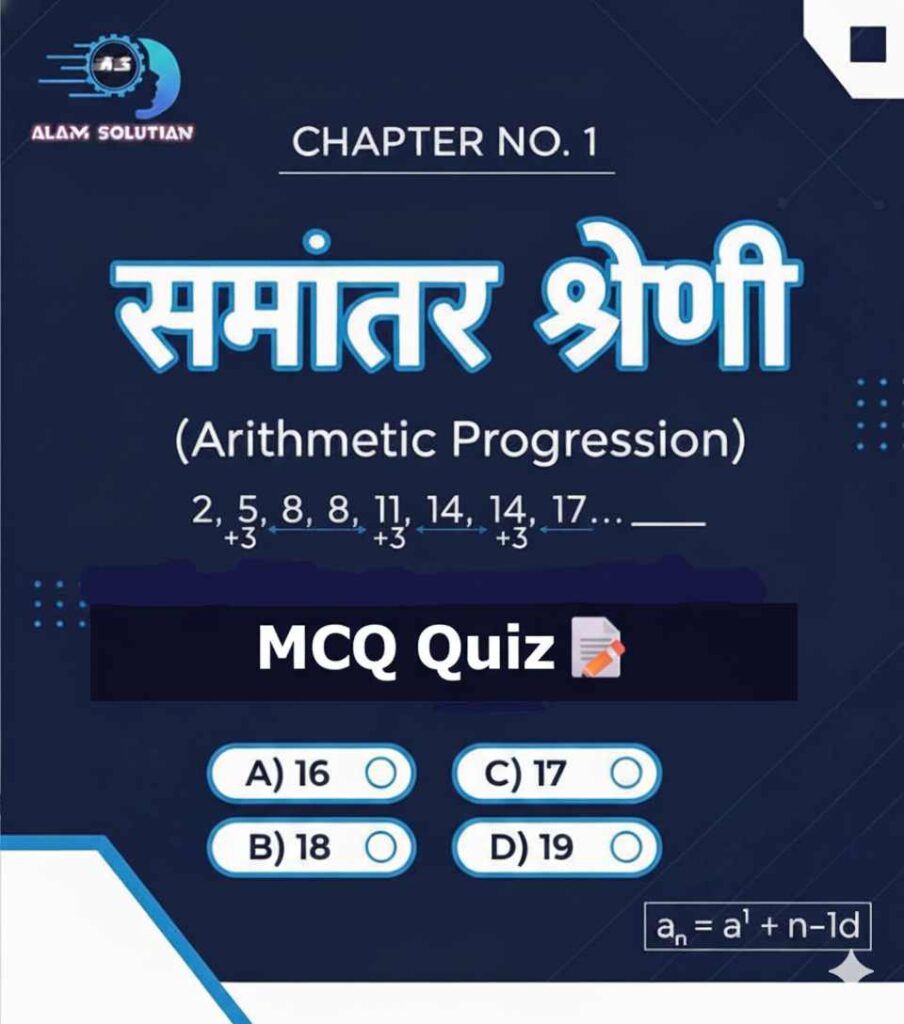
समांतर श्रेणी MCQ Questions and Answers
समांतर श्रेणी MCQ Questions and Answers I यहाँ आपको समांतर श्रेणी (Arithmetic Progression) से जुड़े महत्वपूर्ण MCQs दिए गए हैं। ये प्रश्न Class 10, 12 और Competitive Exams जैसे JAC Board, CBSE, और अन्य परीक्षाओं के लिए बेहद उपयोगी हैं।
हर प्रश्न के साथ सही उत्तर और स्पष्ट व्याख्या दी गई है जिससे आपकी Mathematics preparation आसान और प्रभावी बने।
अगर आप Arithmetic Progression (A.P.) Chapter को जल्दी revise करना चाहते हैं, तो यह MCQ set आपके लिए सबसे उपयुक्त है।
वस्तुनिष्ठ प्रश्न (Objective Type Questions)
☐ बहुविकल्पीय प्रश्न (Multiple Choice Questions)
1. अनुक्रम 5, 14, 23, ….. का 27वाँ पद निम्नलिखित में कौन है?
Which is the 27th term of the sequence 5, 14, 23, …….?
(a) 239
(b) 100
(c) 101
(d) 900
Ans: (a)
2. यदि किसी A.P. में tn = 3n + 5 तो इस A.P का पदान्तर होगा–
In an A.P. if tn = 3n + 5 then the common difference will be :
(a) 1
(b) 2
(c) 3
(d) 4
Ans: (c)
3. यदि किसी A.P के 6वाँ पद तथा 12वाँ पद क्रमशः 13 और 25 हों तो इसका 20वाँ पद होगा–
In an A.P. if 6th and 12th terms are 13 and 25 then its 20th term will be :
(a) 41
(b) 39
(c) 46
(d) 37
Ans: (a)
4. अनुक्रम 5, 7, 9, 11, …. का कौन-सा पद 27 होगा –
Which term will be 27 of the sequence 5, 7, 9, 11, …. :
(a) 13वाँ
(b) 12वाँ
(c) 11वाँ
(d) 10वाँ
Ans: (d)
5. यदि किसी A.P. का pवाँ पद q तथा qवाँ पद p हो तो इसका rवाँ पद है –
If pth term is q and qth term is p of an A.P. then its rth term is :
(a) p + q – r
(b) p – q – r
(c) p + q – r
(d) p – q + r
Ans: (c)
6. समांतर अनुक्रम 2, 5, 8, 11, …. का 10वाँ पद है –
10th term of the A.P. 2, 5, 8, 11, ……… : (J.A.C., 2015, 19)
(a) 47
(b) 43
(c) 37
(d) 28
Ans: (d)
7. यदि किसी समांतर श्रेणी के 9वें पद का 9 गुना 13वें पद का 13 गुना है, तब समांतर श्रेणी का 22वाँ पद है –
If 9 times the 9th term of an A.P. is equal to 13 times to 13th term, then the 22nd term of the A.P. is:
(a) 0
(b) 22
(c) 220
(d) 198
Ans: (a)
8. यदि किसी समांतर श्रेणी के n पदों का योग दिया हुआ है Sn = 3n + 2n², तो समांतर श्रेणी का पदान्तर है –
If the sum of n terms of an A.P. is given by Sn = 3n + 2n², then the common difference of the A.P. is:
(a) 3
(b) 2
(c) 6
(d) 4
Ans: (a)
9. यदि एक समांतर श्रेणी में तीसरा पद 18 और सातवाँ पद 30 हो तो 17वाँ पद है –
If in an A.P. third term is 18 and 7th term is 30, the 17th term is :
(a) 60
(b) 12
(c) 24
(d) 16
Ans: (a)
10. एक समान्तर श्रेणी में पहला पद 1 है और अंतिम पद 11 हैI यदि n पदों का योग 36 है तो n का मान होगा।
If the first term of an A.P is 1 and the last term is 11, and the sum of the n terms is 36, what is the value of n :
(a) 10
(b) 7
(c) 6
(d) 5
Ans: (c)
11. एक समान्तर श्रेणी के 7वें और 13वें पद क्रमशः 34 और 64 हैं। तो श्रेणी का तीसरा पद है –
The 7th and 13th terms of an A.P. are 34 and 64 respectively, then third term of the series is :
(a) 9
(b) 8
(c) 10
(d) 7
Ans: (a)
12. यदि एक समान्तर श्रेणी के 6वें और 12वें पद क्रमशः 13 तथा 25 हैं तो इसका 20वाँ पद होगा –
If 6th and 12th terms of an A.P. are 13 and 25 respectively, then its 20th term is:
(a) 4
(b) 39
(c) 43
(d) 41
Ans: (a)
13. अनुक्रम 10, 5, 0, –5, –10, …… का 10वां पद होगा : (J.A.C., 2015, 20)
The 10th term of sequence 10, 5, 0, –5, –10, …… will be :
(a) 30
(b) 35
(c) –35
(d) –40
Ans: (c)
14. समान्तर श्रेणी 1, 3, 5, 7, …… 99 में कितने पद हैं ? (J.A.C., 2015)
How many terms are there in A.P. 1, 3, 5, 7, …… 99 ?
(a) 40
(b) 30
(c) 45
(d) 50
Ans: (d)
15. समान्तर श्रेणी 7, 14, 21, …… का 15वां पद है : (J.A.C., 2017)
The 15th term of the A.P. 7, 14, 21, …… is:
(a) 98
(b) 91
(c) 105
(d) 100
Ans: (c)
16. यदि 70, k, 100, A.P. में हों तो k का मान होगा : (J.A.C., 2018, 20)
If 70, k, 100 are in A.P., the k is :
(a) 80
(b) 85
(c) 75
(d) 90
Ans: (b)
17. समान्तर श्रेणी (A.P.) 2+5+8+11+ … का 16वां पद होगा :
16th term of A.P: 2+5+8+11+ … will be :
(a) 21
(b) 45
(c) 47
(d) 50
Ans: (c)
18. समान्तर श्रेणी (A.P.) 1, 5, 9, 13, …… का 20वाँ पद है :
20th term of A.P.: 1, 5, 9, 13, …… is :
(a) 76
(b) 77
(c) 75
(d) 101
Ans: (b)
19. समान्तर श्रेणी (A.P.) 2, 4, 6, 8, …… के 25वें पदों का योग होगा :
The sum of A.P. 2, 4, 6, 8, …… upto 25th term will be :
(a) 650
(b) 600
(c) 625
(d) 675
Ans: (a)
20. समान्तर श्रेणी 1, –3, –7, …… 20 पदों का योग होगा :
The sum of A.P 1, –3, –7, …… upto 20th terms will be :
(a) 740
(b) –740
(c) 700
(d) –760
Ans: (b)
21. 1 से 100 तक के मध्य की विषम संख्याओं का योग है :
What is the sum of odd numbers between 1 and 100?
(a) 2,500
(b) 250
(c) 500
(d) 5,000
Ans: (a)
22. एक व्यक्ति प्रथम माह में ₹10 बचाता है, दूसरे माह में ₹20 तथा तीसरे माह में ₹30 बचाता है तथा इसी प्रकार 6 वर्ष तक बचाता है। तो 6 वर्षों में कुल बचत होगी :
If a person saves ₹10 in first month, ₹20 in second month, ₹30 in third month and so on. The total saving of the person in 6 years will be :
(a) ₹26,000
(b) ₹26,280
(c) ₹26,500
(d) ₹26,300
Ans: (b)
23. प्रथम 100 प्राकृतिक संख्याओं का योग ज्ञात कीजिए –
Find the sum of first 100 natural numbers
(a) 5050
(b) 5000
(c) 4950
(d) 4800
Ans: (a)
24. यदि किसी समान्तर श्रेणी के n पदों का योग Sn = 3n+ 2n² है, तो उसका अन्तर ज्ञात कीजिए –
If the sum of n terms of an A.P. is given by Sn = 3n+ 2n², then the common difference is :
(a) 2
(b) 3
(c) 4
(d) 6
Ans: (C)
25. समांतर श्रेणी (AP) का nवाँ पद 5n + 1 है, तो 20वाँ पद होगा: If the nth term of an arithmetic progression (AP) is 5n+1, then the 20th term is:
(a) 101
(b) 79
(c) 78
(d) 103
Ans: (a)
26. एक समान्तर श्रेढ़ी में, 21वाँ पद 151 है और पहला पद 51 है। सार्वांतर ज्ञात कीजिए। In an arithmetic progression, the 21st term is 151 and the first term is 51. Find the common difference.
(a) 6
(b) 5
(c) 7
(d) 4
Ans: (b)
27. यदि एक समांतर श्रेढ़ी का पहला पद 1248 और अंतिम पद 1413 है, तो उसके पहले 34 पदो का योगफल ज्ञात कीजिए। If the first term of an arithmetic progression is 1248 and the last term is 1413, then Find the sum of first 34 terms.
(a) 45235
(b) 45250
(c) 45237
(d) 44237
Ans: (c)
28. तीन अंकों की कितनी संख्याएँ 6 से विभाज्य हैं? How many three-digit numbers are divisible by 6?
(a) 196
(b) 149
(c) 150
(d) 151
Ans: (c)
29. 300 और 1000 के बीच कुल कितनी संख्याएँ 7 से विभाज्य हैं? How many numbers between 300 and 1000 are divisible by 7?
(a) 101
(b) 301
(c) 994
(d) 100
Ans: (d)
30. एक समांतर श्रेणी के पहले 20 पदों का योग जिसका पहला पद 5 है और सार्व अंतर 4 है। Find the sum of the first 20 terms of an arithmetic progression whose first term is 5 and the common difference is 4:
(a) 830
(b) 850
(c) 820
(d) 860
Ans: (d)
🔗 Click Here to Explore ↓